An API response, an app's exported data, a JSON log file: useful data, wrapped in a format spreadsheets do not read directly. Filemorph converts a JSON array of objects into a CSV file, with each object becoming one row and each field becoming one column.
Filemorph collects every field name found across the JSON array to build a consistent set of columns, then writes each object as a row, quoting fields as needed so commas or line breaks inside a value do not break the file. Objects missing a field that others have simply get an empty cell there.
How to convert JSON to CSV on iPhone
Pro
- Add your JSON file. Open Filemorph and pick the .json file from Files or the Share sheet.
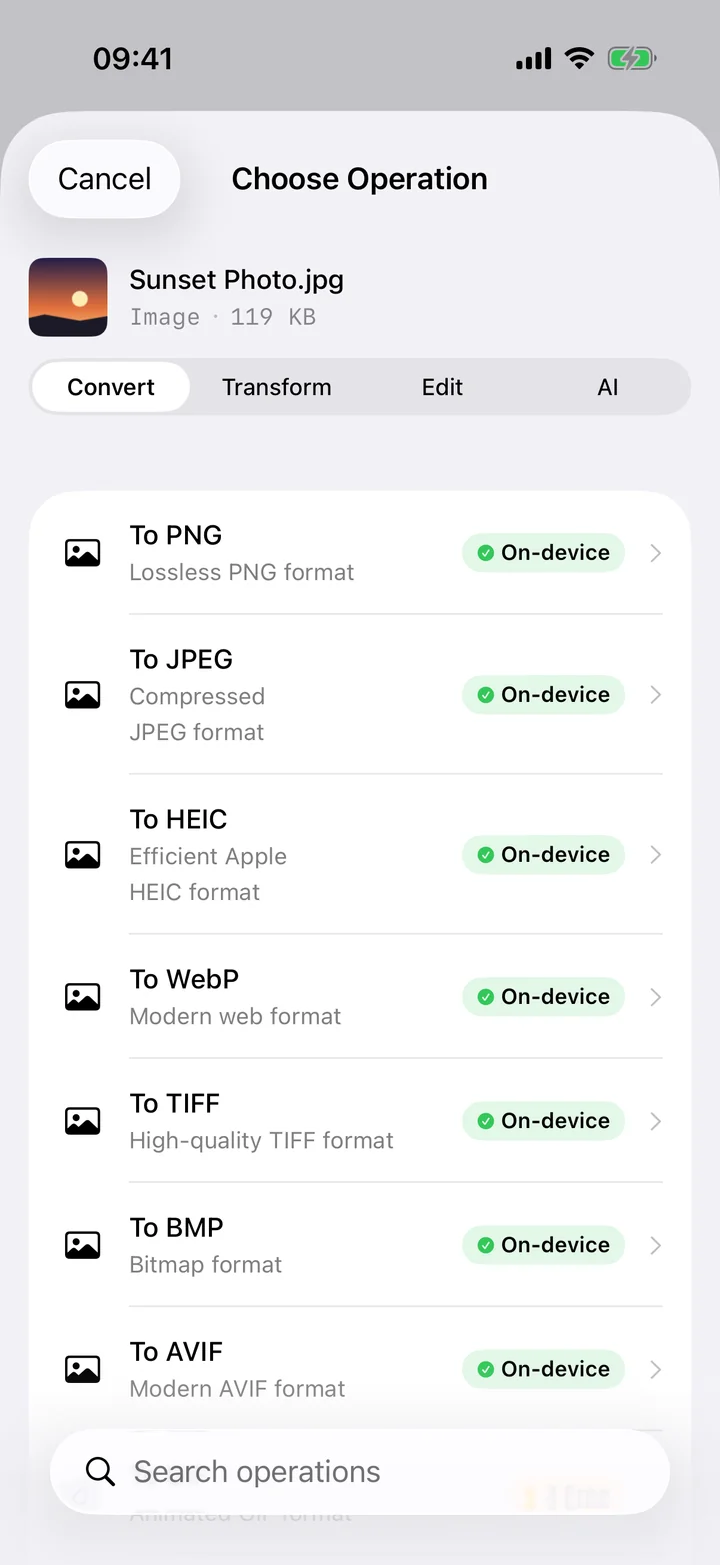
- Choose CSV. Tap Convert and choose CSV as the output format.
- Save or share. Tap Convert. The CSV saves locally, ready to open in Excel, Numbers or Sheets.
In the app: Convert → JSON → CSV.
Why convert JSON to CSV?
Spreadsheets read CSV natively and JSON not at all, so flattening API or app output into CSV is what makes it usable in Excel, Numbers or Sheets for sorting, filtering or a quick chart. It is the fastest path from raw data to something a non-developer can open.
Is it private?
Yes. Unlike web converters that upload your files to a server, Filemorph converts every file locally using Apple's frameworks. Nothing leaves your device, and it works with no internet connection. This operation is part of Filemorph Pro ($29.99/year, 7-day free trial on monthly and annual plans).