Screenshots, scanned documents saved as images, and anything captured with iOS's screenshot tool default to PNG, which is lossless but not space-efficient — a single full-screen PNG on a modern iPhone can run several megabytes. If your camera roll or Files app is filling up with screenshots, converting them to HEIC reclaims real space.
Filemorph re-encodes the PNG through Apple's HEIF encoder. Because HEIC is lossy while PNG is lossless, the pixels are not identical afterward, but at Filemorph's default quality the difference is not visible in normal use, and the file is typically a fraction of the PNG's size.
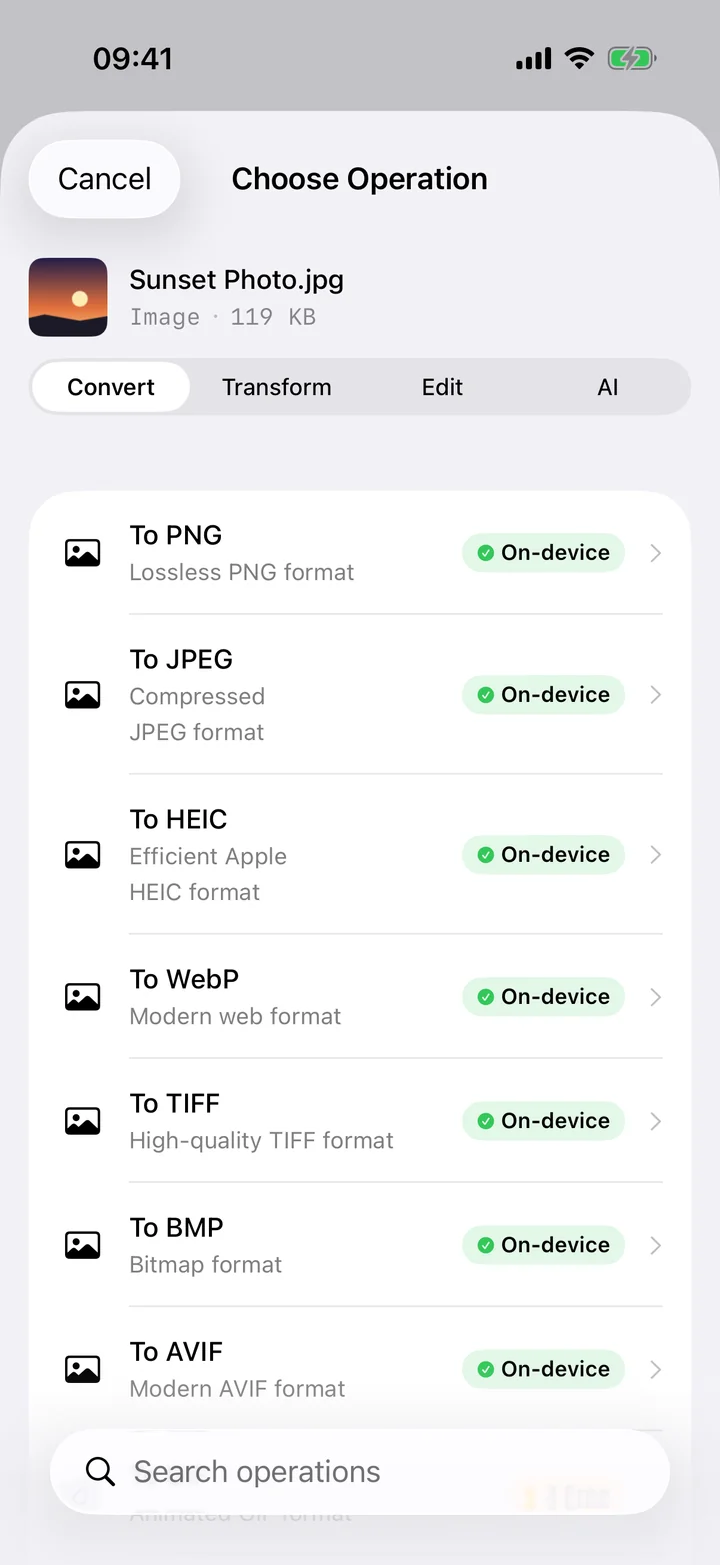
How to convert PNG to HEIC on iPhone
Free
- Add your image. Open Filemorph and pick the PNG from Photos, Files or the Share sheet.
- Choose To HEIC. Tap Convert and choose To HEIC as the output format.
- Save or share. Tap Convert. The HEIC is saved locally — share it, save to Files or AirDrop it.
In the app: Convert → To HEIC.
Why convert PNG to HEIC?
PNG's lossless compression makes sense for graphics with sharp edges, but it wastes space on photo-like screenshots. HEIC trades a small, invisible amount of quality for a much smaller file, which is the right trade for screenshots you are keeping rather than editing.
Is it private?
Yes. Unlike web converters that upload your files to a server, Filemorph converts every file locally using Apple's frameworks. Nothing leaves your device, and it works with no internet connection. This conversion is in the free tier.