Flatbed scanners, some document scanning apps and a handful of cameras still default to TIFF, an uncompressed or lightly-compressed format built for archival quality rather than sharing. A single TIFF scan can run tens of megabytes, which stalls email attachments and blows past messaging limits.
Filemorph decodes the TIFF with ImageIO and re-encodes it as a standard JPG, which compresses the image far more aggressively while staying perfectly readable for sharing or reference. A multi-page TIFF converts its first page; for a multi-page scan you want to keep as one file, convert to PDF instead.
How to convert TIFF to JPG on iPhone
Free
- Add your file. Open Filemorph and pick the TIFF from Files or the Share sheet.
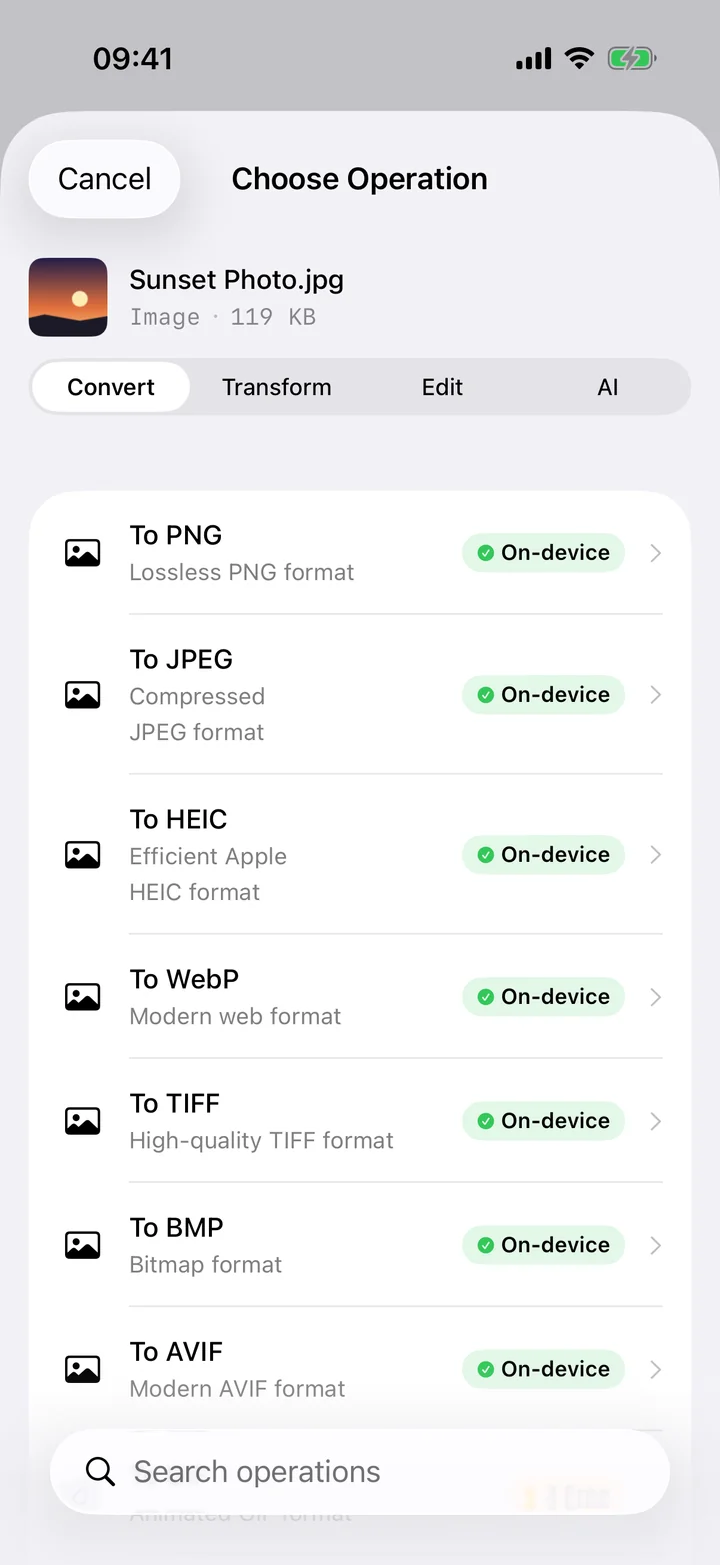
- Choose To JPEG. Tap Convert and choose To JPEG as the output format.
- Save or share. Tap Convert. The JPG is saved locally — share it, save to Files or AirDrop it.
In the app: Convert → To JPEG.
Why convert TIFF to JPG?
JPG is what email, messaging apps and most upload forms expect, and it compresses a scan-sized image down to something you can actually attach or text. Keep the TIFF as an archival master if you have one; convert to JPG for anything you are sending.
Is it private?
Yes. Unlike web converters that upload your files to a server, Filemorph converts every file locally using Apple's frameworks. Nothing leaves your device, and it works with no internet connection. This conversion is in the free tier.