Flatbed scanners and dedicated scanning apps often save each page as a separate TIFF, which is fine for archiving but awkward for anything you actually need to send or file — nobody wants to email twelve separate images when they mean one document. Turning the set into a single PDF is the difference between a folder of scraps and something you can attach.
Filemorph embeds each TIFF as a page in a PDF using UIGraphicsPDFRenderer, keeping the pages in the order you select them. The PDF is a straightforward image-based document — searchable text requires running OCR separately if the underlying page needs a text layer.
How to convert TIFF to PDF on iPhone
Pro
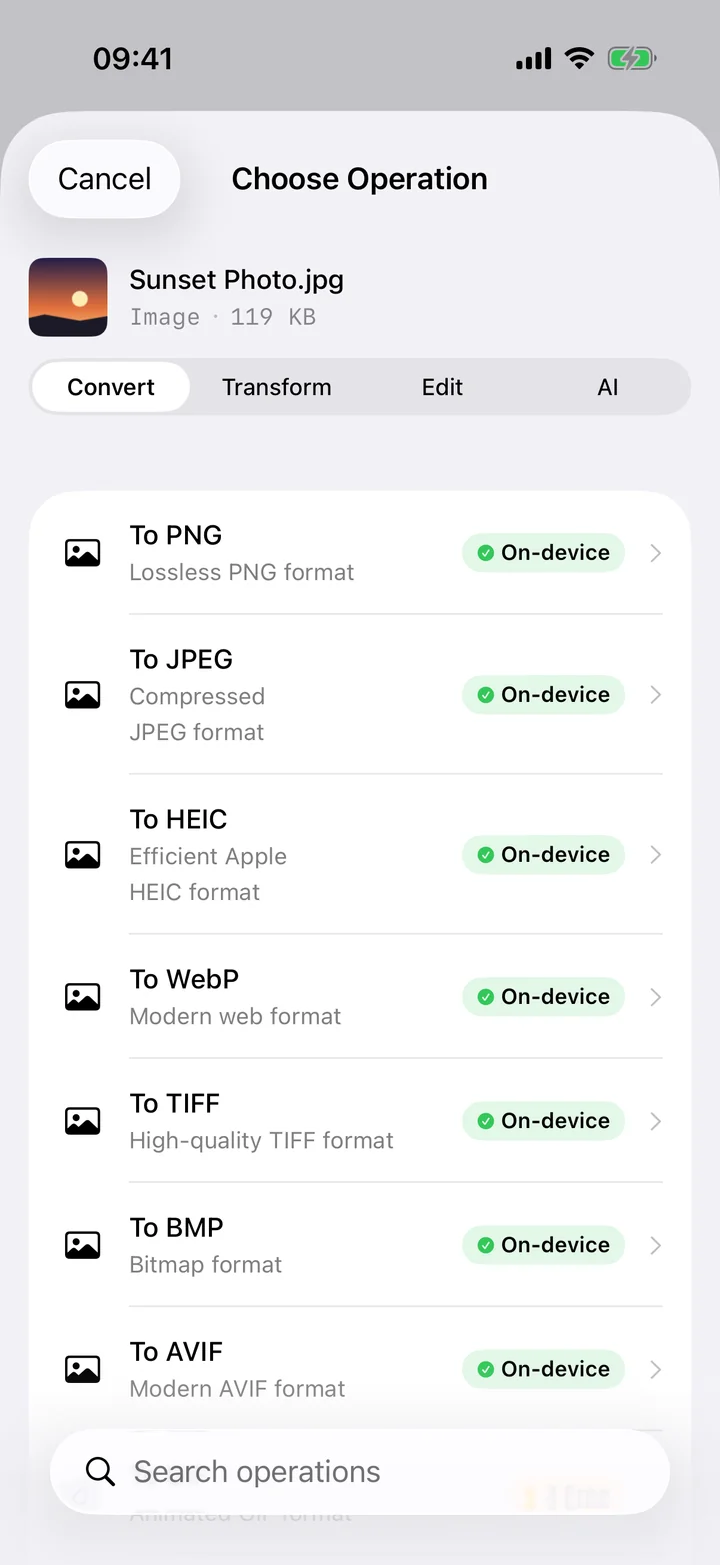
- Add your file. Open Filemorph and pick the TIFF from Files or the Share sheet.
- Choose To PDF. Tap Convert and choose To PDF as the output format.
- Save or share. Tap Convert. The PDF is saved locally — share it, save to Files or AirDrop it.
In the app: Convert → To PDF.
Why convert TIFF to PDF?
PDF is the format people expect for a finished, multi-page document — it opens the same everywhere, keeps pages in order, and is what most offices, banks and government forms ask for. Combine scanned TIFF pages into one PDF instead of sending them as loose image files.
Is it private?
Yes. Unlike web converters that upload your files to a server, Filemorph converts every file locally using Apple's frameworks. Nothing leaves your device, and it works with no internet connection. This operation is part of Filemorph Pro ($29.99/year, 7-day free trial on monthly and annual plans).