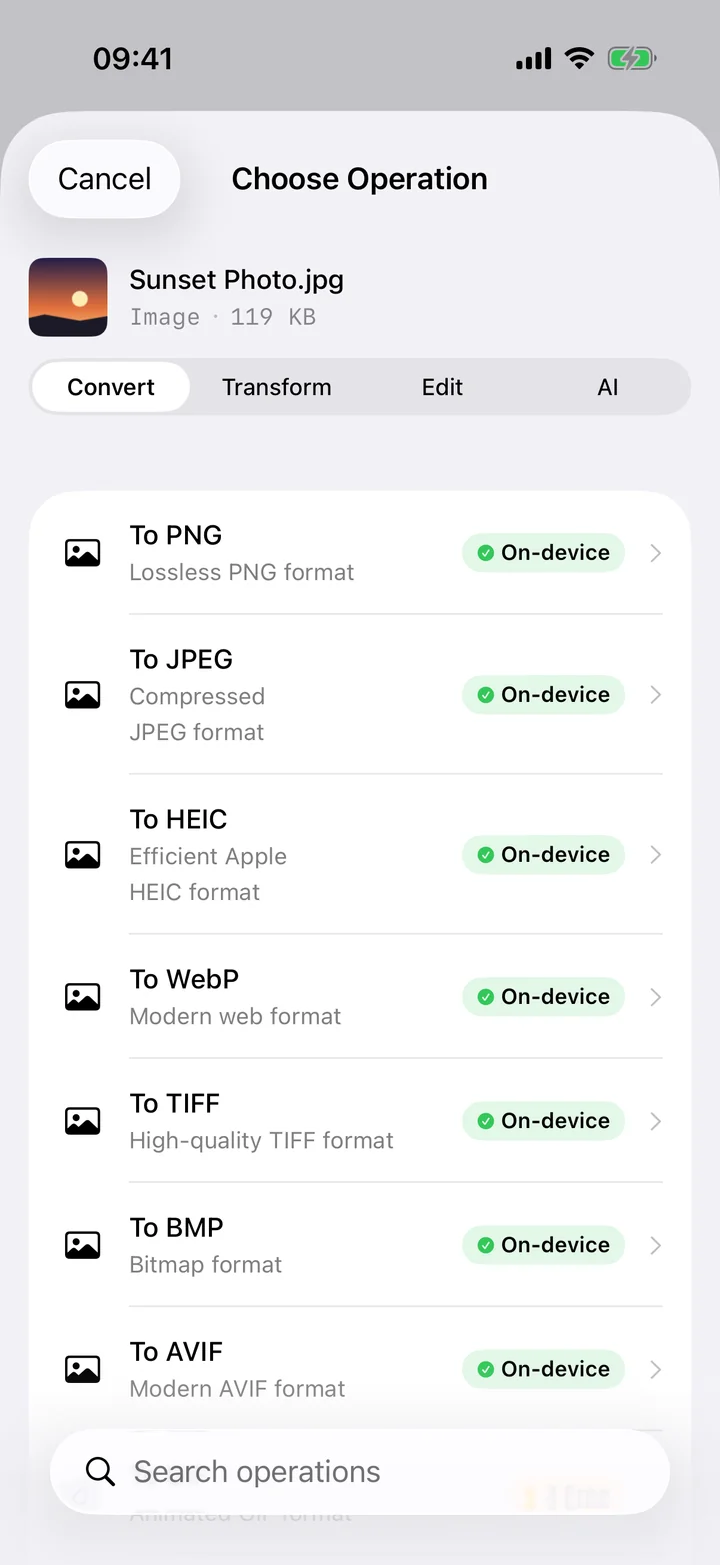
A lossless library is worth keeping exactly as it is — that is the point of FLAC — but a phone, a car system or a streaming app that only understands AAC or MP3 cannot play it directly. Converting a copy to M4A gives you a portable version for those situations without touching the FLAC master.
Filemorph decodes the FLAC and encodes the result to AAC using Apple's AVFoundation, writing an M4A file alongside the original. The FLAC on disk is never modified — this creates a second, smaller file for playback, not a replacement.
How to convert FLAC to M4A on iPhone
Pro
- Add your FLAC file. Open Filemorph and pick the FLAC from Files or the Share sheet.
- Transcode. Tap Transcode and set Output Format to M4A. The same picker offers MP3 at 128 to 320 kbps, WAV and AIFF.
- Save or share. Tap Convert. The M4A saves locally alongside the original FLAC.
In the app: Transcode (Output Format: M4A).
Why convert FLAC to M4A?
Keeping a lossless FLAC library and needing a portable copy for a phone, a car or an app that does not support FLAC are not conflicting goals — you can have both. A smaller M4A copy solves the compatibility problem without giving up the lossless original.
Is it private?
Yes. Unlike web converters that upload your files to a server, Filemorph converts every file locally using Apple's frameworks. Nothing leaves your device, and it works with no internet connection. This operation is part of Filemorph Pro ($29.99/year, 7-day free trial on monthly and annual plans).