WAV stores every sample uncompressed, so a few minutes of stereo audio can run into the hundreds of megabytes. Once editing is done and it is time to archive, sync or share the recording, M4A gets the file down to a fraction of the size at a bitrate most ears cannot distinguish from the original.
Filemorph reads the WAV's PCM audio and encodes it to AAC using Apple's AVFoundation, writing the result into an M4A container. The compression is lossy, so this is a one-way trip — keep the WAV if you might need to edit the recording again later.
How to convert WAV to M4A on iPhone
Pro
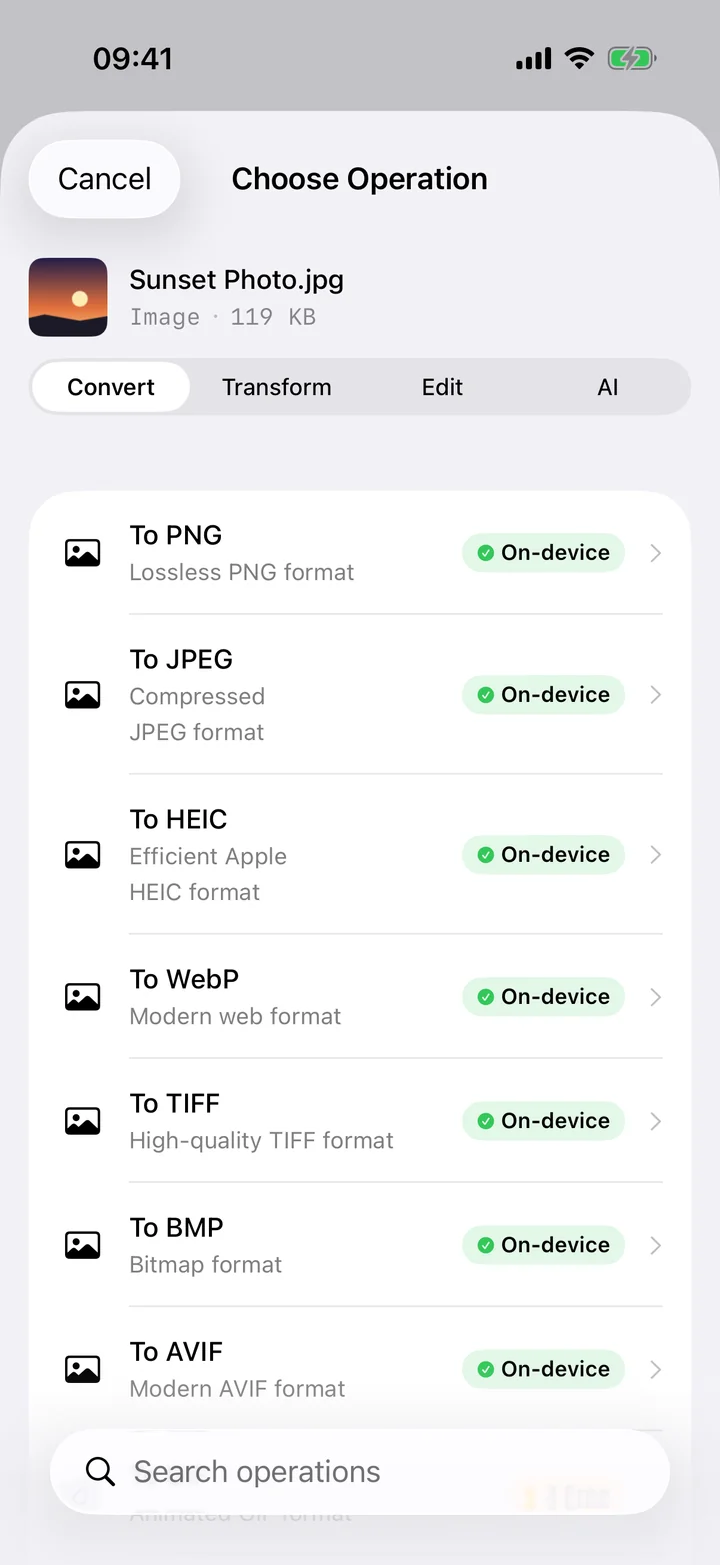
- Add your WAV file. Open Filemorph and pick the WAV from Files or the Share sheet.
- Transcode. Tap Transcode and set Output Format to M4A. The same picker offers MP3 at 128 to 320 kbps, WAV and AIFF.
- Save or share. Tap Convert. The M4A saves locally, a fraction of the WAV's size.
In the app: Transcode (Output Format: M4A).
Why convert WAV to M4A?
A finished recording rarely needs to stay uncompressed once editing is done, and a smaller M4A is faster to send, easier to sync across iCloud and lighter on storage. Keeping the WAV around only as the master copy, and sharing M4A everywhere else, is the usual split.
Is it private?
Yes. Unlike web converters that upload your files to a server, Filemorph converts every file locally using Apple's frameworks. Nothing leaves your device, and it works with no internet connection. This operation is part of Filemorph Pro ($29.99/year, 7-day free trial on monthly and annual plans).